
You’ve lived with back, neck, or arm pain long enough to know the difference between a bad day and a bad month. Between heating pads, online stretches, and anti-inflammatories that upset your stomach, you’ve tried it all.
Now, someone has mentioned an epidural steroid injection (ESI). Whether it was your doctor, a friend, or a 2 a.m. Google search, the idea brings a mix of hope and hesitation. Needles near the spine sound serious.
This guide provides clarity. We aren’t here to sell you on a procedure, but to help you understand what an ESI involves, what it realistically achieves, and the questions you should ask before scheduling your appointment.
What’s an Epidural Steroid Injection (ESI)?
An epidural steroid injection delivers medication directly into the epidural space of your spine, which is the area between your vertebrae and the protective sac surrounding your spinal nerves.
Unlike oral pills, which circulate throughout your entire system, an ESI offers precision. The injection typically contains:
- A Corticosteroid: A powerful anti-inflammatory to reduce swelling.
- A Local Anesthetic: To provide immediate, short-term numbing.
Common Conditions Treated with ESI:
- Herniated or Bulging Discs: Pressing on spinal nerves.
- Spinal Stenosis: Narrowing of the spinal canal.
- Degenerative Disc Disease: Wear and tear of spinal cushions.
- Sciatica & Radiculopathy: Nerve pain radiating into the arms or legs.
The Reality Check: An ESI is an intervention to interrupt the pain cycle. It’s not surgery, and it’s not a “cure” for structural issues, but rather a tool to make recovery and physical therapy possible again.
Does it Work? Why Results Vary
Research in journals like Spine Health suggests that 70–80% of patients experience significant relief. However, success depends on three factors:
- The Diagnosis: Patients with acute disc herniations and shooting nerve pain (radicular pain) usually see better results than those with general, dull muscle aches.
- The Timing: Intervening before pain becomes centralized (chronic for many years) often leads to better outcomes.
- The “Window” Strategy: The injection works best as a window of opportunity. By reducing pain for a few months, you can perform the physical therapy needed for long-term healing.
Step-by-Step: What to Expect During the Procedure
Fear often stems from the unknown. Here’s the clinical reality of the procedure room:
1. Preparation and Positioning
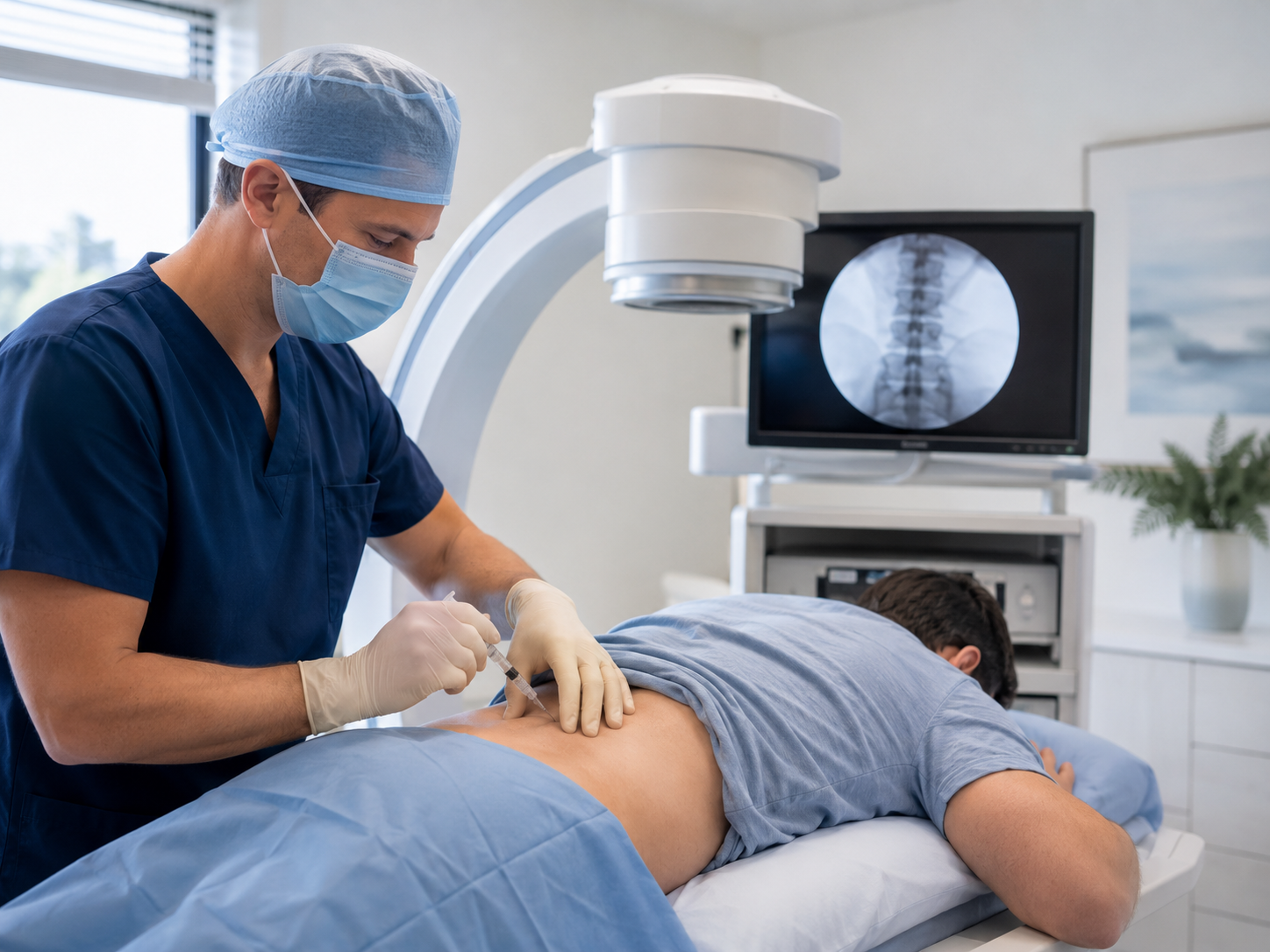
You’ll likely be asked to fast for a few hours if you’ve opted for mild sedation. In the procedure room, you’ll lie face down on a specialized table.
The area is cleaned with an antiseptic and numbed with a tiny needle. This is usually the only sting you’ll feel.
2. The Role of Fluoroscopy (Live X-Ray)
At Florida Spine & Pain Institute, we never guess the location. We use Fluoroscopy, a real-time X-ray, to guide the needle to the exact millimeter. We often use a small amount of contrast dye to confirm that the medicine will flow exactly around the irritated nerve.
3. The Injection
Once the needle is perfectly placed, the steroid/anesthetic mix is administered. You may feel pressure or a brief fullness in your back or leg. The actual injection takes less than five minutes.
4. Immediate Aftercare
You’ll spend about 20 minutes in recovery. Because of the local anesthetic, your legs might feel slightly heavy or fuzzy. You’ll need a driver to take you home, and you should take it easy for the first 24 hours.
Benefits vs. Risks: A Plain-English Breakdown
Before you decide, it helps to understand what you may gain and the risks.
The Benefits
- Targeted Inflammation Reduction: Hits the pain at the source.
- Functional Gains: Allows you to sit, walk, and sleep again.
- Diagnostic Confirmation: If the injection works, it confirms exactly which nerve was causing the trouble.
- Avoiding Surgery: For many, successful injections can delay or even eliminate the need for an operation.
The Risks
While serious complications are rare, you should be aware of:
- Minor: Temporary “steroid flare” (increased pain), facial flushing, or insomnia for 24 hours.
- Rare: Infection, dural puncture (spinal headache), or bleeding.
- Diabetic Note: Steroids can temporarily raise blood sugar levels.
The Question Most People Forget to Ask
Most patients ask, “Will it hurt?” The more important question is:
“What is the plan if this works, and what is the plan if it doesn’t?”
At Florida Spine & Pain Institute, we don’t view an injection as a one-off event. We see it as part of a comprehensive roadmap. Before your procedure, we’ll discuss:
- The ideal time to start Physical Therapy.
- How many injections are safe for your specific bone density.
- Alternative treatments if the ESI provides limited relief.
Frequently Asked Questions About Epidural Steroid Injection
How long does an ESI last?
It varies. Some get weeks of relief; others get months. If it’s an acute injury (like a fresh herniated disc), one injection might be all you need to get over the hump.
Is the procedure painful?
It’s more of a pressure sensation than sharp pain. We use local numbing, and sedation options are available for those who feel anxious.
Can this replace surgery?
Often, yes. By reducing irritation around the nerve, the body may naturally shrink the herniated disc over time, helping many patients avoid surgery.
Schedule an Appointment for Epidural Steroid Injections in Central Florida
If neck, arm, back, or leg pain has been controlling your days, you don’t have to keep pushing through it alone. When inflamed spinal nerves are involved, the right treatment can make a real difference in how you move, sleep, and function.
At Florida Spine & Pain Institute in Central Florida, your care is led by double board-certified Dr. Javier Placer and a team experienced in treating complex, chronic pain.
We use modern interventional options, including epidural steroid injections, to target inflammation at the source and help relieve the pain that radiates through your body.
Interventional pain management is what we do every day, and long-term relief is always the goal.
If you’re ready to take the next step, book an appointment today, and let’s build a plan that supports your comfort and quality of life.